

How to Choose the Best Hair Removal Laser Machine?
Choosing the best Hair Removal Laser Machine begins with a practical question: who will use it, and who will receive the treatment? A salon, medical clinic, and mobile practitioner may need very different systems. Treatment goals also vary. Coarse black hair may respond well, while blond, red, gray, or fine hair can be more difficult. Skin tone matters too. A machine must offer suitable wavelengths, adjustable fluence, reliable cooling, and controlled pulse duration.
Dermatologist and laser-treatment specialist Dr. Tina Alster explains, “Laser hair removal is not permanent hair removal; it is permanent hair reduction.” This distinction matters. A responsible buyer should examine clinical evidence, operator training, maintenance support, and realistic treatment claims. A bright screen and impressive brochure prove little. Sometimes, the quiet details matter more.
Look for systems designed with multiple skin types in mind. Alexandrite, diode, and Nd:YAG technologies each have different strengths and limitations. Ask whether the manufacturer provides treatment protocols, safety guidance, and technical servicing. Confirm that the device has appropriate regulatory clearance in your market. A patch test and professional consultation should remain part of the process.
Price can mislead. The cheapest Hair Removal Laser Machine may create higher costs through downtime, poor results, or replacement parts. The most expensive model may also be unnecessary. This is where judgment becomes difficult. A careful comparison should include comfort, consistency, training, warranty coverage, and expected workload. No machine removes every uncertainty. The best choice balances performance, safety, evidence, and honest expectations.
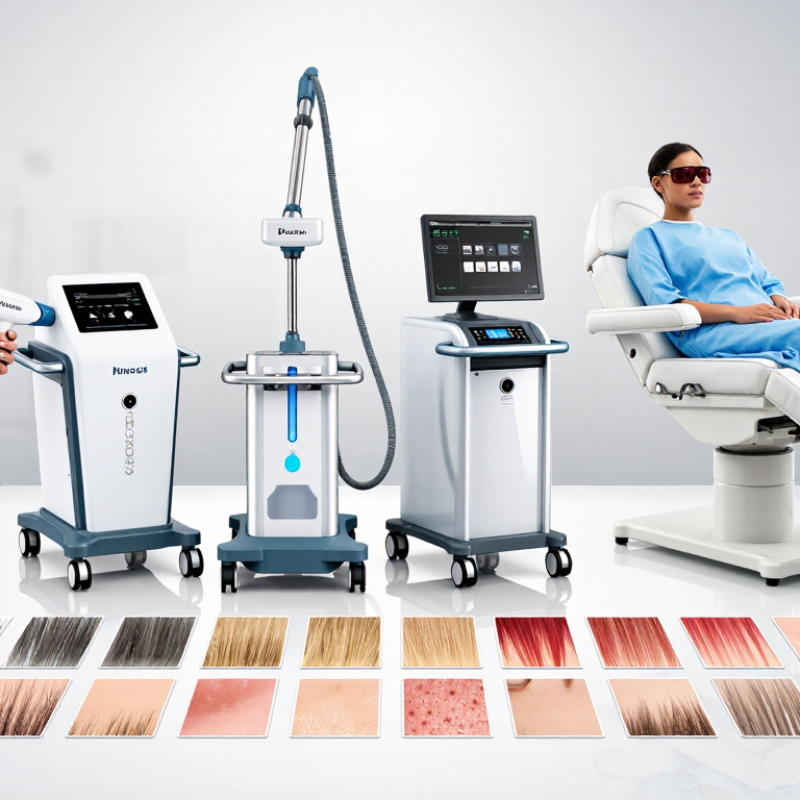
Define Your Hair Removal Goals and Treatment Requirements
Before choosing a hair removal laser machine, define the treatment goal precisely. Do you need facial work, large-area treatments, or both? The American Academy of Dermatology reports that most patients need six or more sessions. Maintenance treatments may still be necessary. Your plan should reflect skin tone, hair thickness, hair color, body area, and pain tolerance.
A 2023 ISAPS Global Survey recorded more than 1.5 million nonsurgical hair-removal procedures worldwide. This demand does not make every device suitable. Darker skin requires carefully controlled energy and reliable cooling. Fine facial hair may need different pulse settings than coarse leg hair. Check the machine’s wavelength options, spot size, cooling method, treatment speed, and adjustment range. Operator training matters just as much. A technically advanced device can still produce poor results in inexperienced hands.
Be specific.
Ask how results will be measured. Use standardized photographs, treatment intervals, and hair-count records. Do not rely only on customer impressions. A 2024 review in Lasers in Medical Science emphasizes that outcomes vary with hair biology, skin characteristics, and treatment parameters. That uncertainty is easy to underestimate. I would also examine service records, calibration procedures, and clinical training documents before purchase. A cheaper machine may become expensive through downtime, inconsistent results, or repeated sessions. No report can predict every patient response, so your equipment choice should leave room for careful testing and honest review.
| Hair Removal Goal | Recommended Light Source or Wavelength | Suitable Skin and Hair Profiles | Key Treatment Requirements | Important Limitations | Selection Priority |
|---|---|---|---|---|---|
| Fast treatment of large areas | Diode laser around 800–810 nm, or a system with a large spot size and high repetition rate | Most effective on brown to black hair with a clear contrast between the hair and the skin | Large spot size Reliable cooling Short recharge time Consistent energy delivery | Very light, red, gray, or white hair contains limited melanin and may respond poorly. Large treatment areas still require careful skin assessment. | Prioritize coverage speed, cooling performance, ergonomics, and stable output. |
| Hair removal for light skin with dark, coarse hair | Alexandrite laser at approximately 755 nm, or a suitable diode platform | Commonly selected for lighter Fitzpatrick skin types I–III with dark, melanin-rich hair | Accurate pulse control Adjustable fluence Effective cooling Small and large spot options | The shorter wavelength has greater melanin absorption, so the risk of epidermal heating is higher on tanned or darker skin. | Prioritize pigment safety, cooling, pulse-width adjustment, and operator training. |
| Hair removal for darker skin tones | Long-pulsed Nd:YAG laser at 1064 nm | Often preferred for Fitzpatrick skin types IV–VI because the longer wavelength penetrates deeper and is less strongly absorbed by epidermal melanin | Long-pulse capability Strong cooling Wide parameter range Conservative test spots | It may require more treatment sessions or higher clinical expertise for fine or less pigmented hair. Tanned skin still requires caution. | Prioritize epidermal protection, cooling, adjustable pulse duration, and skin-type safety protocols. |
| Versatile treatment across different skin types | Multi-wavelength platform combining approximately 755 nm, 810 nm, and 1064 nm | A broad range of skin types and hair thicknesses, provided the operator selects appropriate parameters | Independent wavelength control Multiple spot sizes Skin cooling Clear treatment presets | More wavelengths do not automatically mean better results. Performance depends on calibration, optical design, cooling, and operator skill. | Prioritize genuine wavelength control, verified output consistency, serviceability, and training. |
| Precision treatment of small or sensitive areas | Laser handpiece with a small spot size; wavelength should be selected according to skin type and hair characteristics | Suitable for areas such as the face, underarms, bikini line, and other anatomically sensitive zones | Small spot option Comfortable handpiece Precise aiming Strong contact cooling | Hormonal conditions can influence facial-hair response. Treatment around the eyes requires strict protective procedures and appropriate equipment. | Prioritize precision, comfort, visibility, handpiece balance, and safety features. |
| Reducing discomfort during treatment | Any clinically appropriate laser wavelength equipped with integrated contact, air, or sapphire cooling | Useful for clients with low pain tolerance or for areas where hair is dense and coarse | Pre-cooling Contact cooling Adjustable repetition rate Stable treatment temperature | Cooling improves comfort but does not eliminate the need for correct fluence, pulse duration, skin assessment, and protective eyewear. | Evaluate cooling performance under continuous use rather than relying only on advertised temperature values. |
| High-volume professional operation | Professional diode, alexandrite, or Nd:YAG platform selected according to the clinic's client mix | Clinics treating multiple skin types and large numbers of clients | High duty cycle Fast repetition rate Replaceable consumables Preventive maintenance access | Frequent operation increases the importance of cooling-system maintenance, handpiece durability, calibration, and electrical safety. | Prioritize uptime, output testing, warranty coverage, technical support, and total operating cost. |
| Lower initial investment for general cosmetic use | IPL may be considered when the treatment goal and skin profile are appropriate; it is broad-spectrum light, not a laser | Typically more suitable for lighter skin with darker hair and carefully selected treatment areas | Interchangeable filters Reliable cooling Appropriate pulse control Qualified operation | IPL is less selective than a single-wavelength laser and may have a narrower safety margin for darker or recently tanned skin. | Choose IPL only when its broader spectrum matches the intended use, safety process, and client population. |
| Predictable long-term reduction | A clinically appropriate laser system matched to hair pigment, skin type, treatment area, and growth cycle | Best response is generally associated with actively growing, pigmented hair; results vary between individuals | Treatment scheduling Parameter documentation Progress photography Maintenance planning | Hair removal is usually progressive rather than permanent after one session. Hormonal factors, medications, and hair-growth cycles affect outcomes. | Prioritize a repeatable protocol and realistic client expectations over maximum energy specifications. |
| Safe procurement and compliance | A professionally manufactured device with documentation appropriate to the intended country and use environment | Any clinic or practitioner requiring controlled, traceable treatment procedures | Regulatory documentation User training Protective eyewear Emergency procedures Service records | Regulatory requirements differ by country. Certification or registration does not replace clinical training, risk assessment, or proper maintenance. | Verify legal status, safety documentation, calibration support, training, and after-sales service before purchase. |