
• NEWS AND UPDATES

    The latest updates regarding our products and our company

Best Medical Laboratory Equipment for Accurate Testing?

In the realm of healthcare, medical laboratory equipment plays a crucial role in delivering accurate test results. According to a report by Global Market Insights, the medical laboratory equipment market is projected to reach $50 billion by 2025. This growth emphasizes the industry's reliance on advanced technologies and precise instruments. Accurate diagnostics can significantly improve patient outcomes, yet the selection of appropriate equipment remains a complex challenge.

Quality and reliability are vital for any laboratory. For instance, misdiagnosis can stem from inadequate or faulty instruments. A study published in the Journal of Clinical Pathology revealed that nearly 30% of laboratory errors are linked to equipment malfunctions. This raises critical questions about the current state of medical laboratory equipment. Are we investing enough in cutting-edge tools? Are technicians adequately trained to handle sophisticated devices?

As laboratories seek to enhance testing accuracy, they must also reflect on the importance of maintenance and regular upgrades. It is not enough to have the latest technology; ensuring consistent performance is essential. There is a pressing need to evaluate existing processes and equipment regularly, allowing laboratories to remain integral to patient care and safety.

Best Medical Laboratory Equipment for Accurate Testing?

Overview of Medical Laboratory Equipment and Its Importance in Testing

Medical laboratory equipment plays a crucial role in obtaining accurate test results. Various instruments are used for different types of tests, such as blood analysis or microbiology. Each piece of equipment contributes to a precise understanding of a patient’s health condition. Common tools include centrifuges, microscopes, and analyzers. These devices help laboratory technicians ensure the highest quality in testing.

However, not all equipment may function as expected. Regular maintenance is essential to prevent malfunctions that can lead to erroneous results. In some cases, outdated technology might hinder the testing process. This can pose risks to patient care and delay necessary treatments. Proper training for laboratory staff is equally important. Knowledgeable technicians can operate equipment effectively and troubleshoot issues that may arise.

Quality assurance protocols are vital. They help establish the accuracy of results. Laboratories often conduct routine checks to validate instrument performance. Yet, discrepancies can still occur, prompting a need for continuous improvement. Access to accurate results can significantly influence patient outcomes, stressing the importance of reliable laboratory equipment and practices.
Key Features of Accurate Diagnostic Instruments in Medical Laboratories

Accurate diagnostic instruments are vital in medical laboratories. They ensure reliable results that clinicians depend on for patient care. Key features are essential for such instruments. For instance, sensitivity and specificity must be high. A tool with low sensitivity may miss critical conditions. This can lead to misdiagnosis and ineffective treatments.

Another critical feature is precision. Test results should be consistent across multiple uses. Variability can cause confusion and trust issues in results. Additionally, user interface plays a significant role. A complicated interface can lead to errors during operation. Training staff to use these tools effectively is necessary. However, even well-trained personnel can make mistakes under pressure.

Calibration of instruments should be done regularly. Over time, their accuracy might degrade. Even slight deviations can alter results significantly. The opportunity for human error is always present. In highly sensitive environments, every detail counts. Regular reviews and updates are crucial for maintaining high standards. While many labs strive for perfection, the road to accuracy has many bumps.

Best Medical Laboratory Equipment for Accurate Testing

This chart displays the accuracy scores of various medical laboratory equipment essential for accurate diagnostic testing. The scores reflect the performance quality of each equipment type, helping laboratories ensure reliable test results.

Top Medical Lab Equipment Types and Their Specific Functions

Medical laboratories require various equipment for accurate testing. One essential type is the centrifuge. This device separates components of blood and other fluids. It spins samples at high speeds, creating distinct layers. Accuracy depends on the speed and time settings. If not calibrated correctly, results can be misleading.

Another crucial piece is the spectrophotometer. This equipment measures the intensity of light in different wavelengths. It helps identify substances in a sample based on light absorption. Regular maintenance is necessary for precision. A dirty lens can cause errors in the results.

Microscopes are indispensable in labs. They allow scientists to see tiny structures in samples. Understanding cell structure is vital for many tests. Sometimes, the resolution isn’t as clear. Adjustments may be needed after prolonged use. Regular checks can prevent potential mishaps. These instruments play a significant role in diagnostics and research.

Best Medical Laboratory Equipment for Accurate Testing

Equipment Type Function Accuracy Common Uses
Spectrophotometer Measuring light absorbance ±0.001 Abs Clinical chemistry, blood analysis
Centrifuge Separating substances of different densities N/A Plasma/serum preparation
PCR Machine Amplifying DNA segments High sensitivity Genetic testing, research
Microscope Observing small or microscopic samples Varies with type Pathology, microbiology
Hemoglobin Analyzer Measuring hemoglobin concentration ±0.1 g/dL Complete blood count (CBC)

Latest Innovations in Medical Laboratory Technology for Enhanced Accuracy

Best Medical Laboratory Equipment for Accurate Testing?

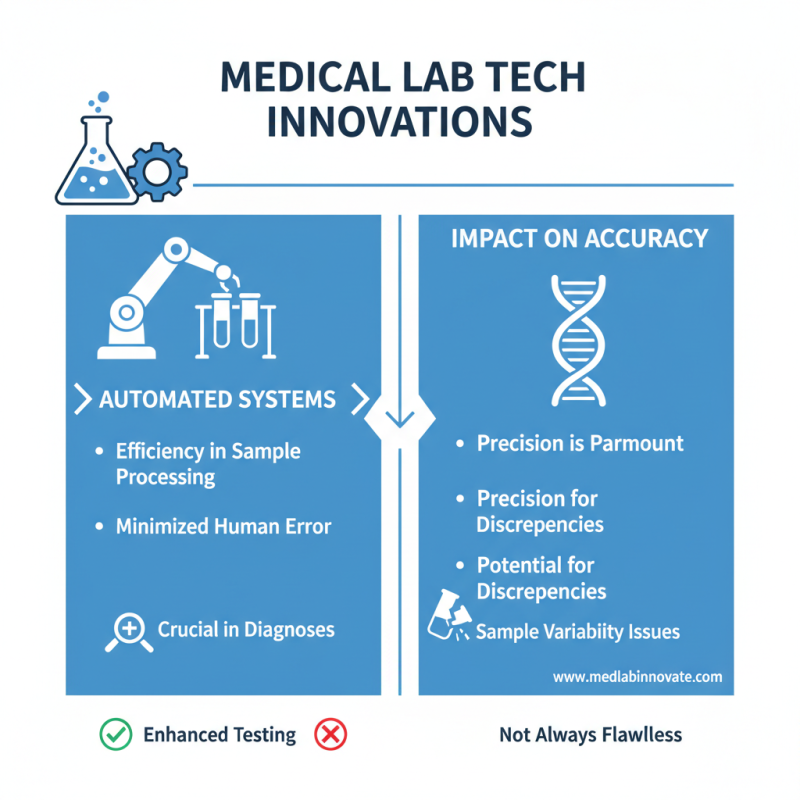
Innovations in medical laboratory technology significantly impact testing accuracy. For instance, the introduction of automated systems enhances efficiency in sample processing. These systems minimize human error, which is crucial in diagnoses. Precision is paramount, yet not all automation is flawless. Some may fail to account for sample variability, leading to discrepancies.

Next-generation sequencing is another critical advancement. This technology allows for comprehensive genetic analysis, offering insights into complex conditions. While it improves understanding, it also raises concerns about data interpretation. Misinterpretation can lead to incorrect conclusions, posing risks to patient care. It's essential to ensure that lab professionals are adequately trained to understand these technologies.

In addition to these innovations, real-time data analytics provide immediate feedback in lab results. This capability supports quicker decision-making for clinicians. However, reliance on technology can sometimes overshadow the importance of human judgment in test evaluations. Balancing technological reliance and expert analysis is vital for reliable laboratory outcomes.

Regulatory Standards and Quality Assurance in Lab Equipment Selection

When selecting medical laboratory equipment, regulatory standards play a critical role. Compliance ensures that the equipment meets essential safety and quality benchmarks. Laboratories need to adhere to guidelines set by health authorities. These regulations guide the choice of equipment for reliable and precise testing outcomes.

Tips: Always check for certifications. Look for compliance with local and international standards. This builds trust in your equipment and results.

Quality assurance is equally important. It involves regular calibration and maintenance of devices. Frequent checks can prevent errors that may arise from worn-out parts or software malfunctions. Continuous training of the laboratory staff is crucial. They must understand equipment functionality to ensure accurate testing.

Tips: Schedule routine checks. Keep a maintenance log for all equipment. Don’t overlook staff training sessions; they are vital for quality results.

Finding the right balance of regulations and quality assurance can improve lab results. However, it also requires ongoing effort and reflection. Remember that meeting standards is a dynamic process, not a one-time task. Regular audits can reveal areas for improvement.